

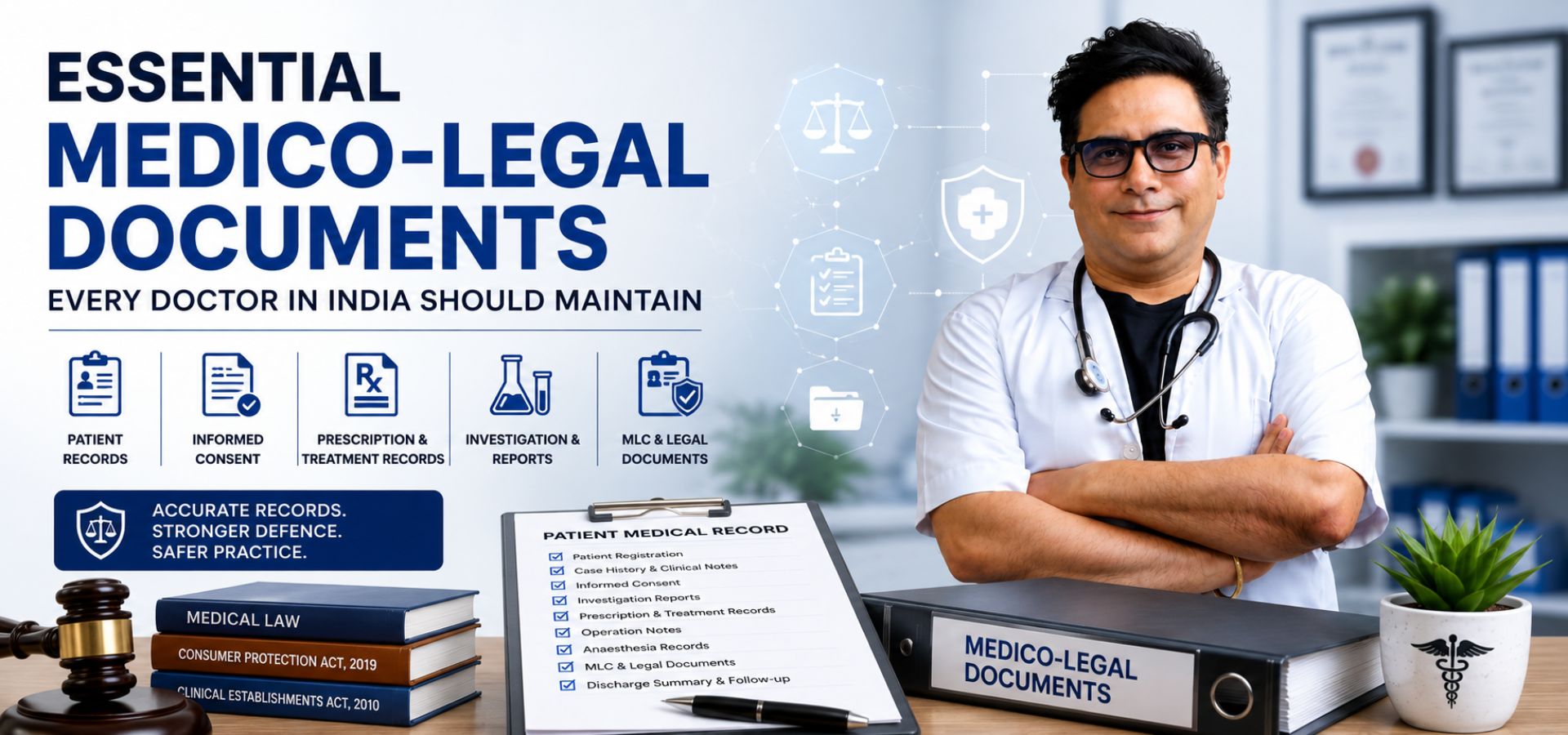
The practice of medicine in India carries with it a weight of responsibility that extends far beyond the examination room. Alongside the clinical obligations of diagnosis and treatment lies an equally critical set of administrative and legal duties — the maintenance of comprehensive, accurate, and legally sound documentation.
In an era of rising patient awareness, increased litigation, and tightening regulatory oversight, medico-legal documents for doctors are no longer optional additions to good practice. They are foundational to it. Whether a matter involves a consumer complaint, a clinical negligence claim, or a regulatory inspection, the strength of a doctor's position will often rest entirely on the quality and completeness of their records.
Why Documentation Is a Pillar of Ethical and Legal Practice
Medical records serve two equally important functions: they support quality clinical care by ensuring continuity and accuracy of treatment, and they provide a contemporaneous account of clinical decisions that can be referred to in the event of a dispute or investigation.
Under the Consumer Protection Act, 2019, patients are classified as consumers and healthcare providers are accountable for service deficiencies. The Indian Medical Council (Professional Conduct, Etiquette and Ethics) Regulations, 2002 also mandate the maintenance of appropriate records. Beyond these, guidelines issued by the Medical Council of India and various state medical councils further reinforce the obligation to document comprehensively and retain records for the prescribed duration.
When complaints arise — whether before a consumer forum, a state medical council, or a civil court — medico-legal documents for doctors become the primary line of defence. In their absence, even a clinically sound decision can become difficult to defend.
Core Medico-Legal Documents Every Doctor Must Maintain
The following ten categories of documentation form the essential medico-legal record base for every practising doctor in India — whether in a solo clinic, group practice, or hospital setting.
Every clinical encounter should begin with the collection and verification of the patient's basic identity information — full name, age, gender, address, contact details, and a valid identity document number. This creates an unambiguous record of who received care and when, forming the foundation of all subsequent documentation.
Detailed, contemporaneous clinical notes are among the most important medical records doctors should maintain. These should capture the patient's presenting complaints, history of present illness, relevant past medical and family history, allergies, current medications, and findings of a thorough physical examination. Notes should be legible, dated, timed, and signed — with corrections made by striking through with a single line and initialling, never by erasing or overwriting.
Obtaining and recording informed consent is both an ethical requirement and a legal safeguard. Consent forms must clearly articulate the proposed procedure or treatment, its anticipated benefits, foreseeable risks and complications, available alternatives, and the consequences of declining treatment. For any surgical, invasive, or high-risk intervention, written consent is non-negotiable. Courts have increasingly scrutinised the quality of consent documentation in medical negligence cases — a vague or generic consent form offers little protection.
All laboratory investigations requested by the treating doctor — along with their results — must be retained as part of the patient file. This includes blood reports, urine analyses, culture and sensitivity reports, biopsy findings, radiology and imaging reports, ECG tracings, and any other diagnostic outputs. These records support clinical decision-making and demonstrate the rational basis for the treatment chosen.
Every prescription issued must carry the doctor's registration number, the date, the patient's name, age, and full details of the prescribed medication — drug name, dosage, frequency, route of administration, and duration. Prescription pads should be pre-printed with the doctor's name, qualifications, and registration number in compliance with the Drugs and Cosmetics Act. Records of all treatments administered — including injections, procedures, dressings, or IV therapies — should be maintained in the case file.
For any surgical or procedural intervention, a detailed operative note must be written immediately after the procedure. This should include the pre-operative diagnosis, procedure performed, surgical findings, technique used, complications encountered, and post-operative plan. Anaesthesia records — covering type of anaesthesia, dosage, monitoring parameters, and the patient's response — form an equally vital component of legal documents for doctors performing surgical procedures.
When a patient is referred to another specialist or facility, a formal referral letter summarising the clinical history, investigations conducted, working diagnosis, and reason for referral must accompany the patient. Consultation responses received from other practitioners should be filed in the patient's record. These letters demonstrate coordinated, responsible care and are particularly important if outcomes are later questioned.
A comprehensive discharge summary must be prepared for every admitted patient at the time of leaving the facility. This document should capture the admission diagnosis, summary of clinical course, investigations conducted during admission, procedures performed, final diagnosis, discharge medications with dosages and instructions, follow-up schedule, and emergency contact instructions. The discharge summary is one of the most frequently requested documents during consumer complaints and court proceedings.
In cases involving patient death, the cause of death certificate must be issued accurately and promptly. Where a case has medico-legal implications — including accidents, poisoning, assault, suspicious injuries, or deaths in unexplained circumstances — a Medico-Legal Case register must be maintained and the appropriate authorities notified as required by law. Failure to report such cases or incomplete MLC documentation carries serious legal consequences.
Doctors who dispense medications directly from their clinic are required to maintain dispensing records in compliance with the Drugs and Cosmetics Act and Rules. Schedule H and Schedule H1 drugs must be tracked and recorded meticulously. Narcotic and psychotropic substances are subject to additional regulatory requirements under the NDPS Act, 1985, and require separate register maintenance with periodic submission to the relevant authorities.
Retention Periods and Record Security
The Medical Council of India recommends retaining patient records for a minimum of three years from the date of the last consultation. However, for cases involving minors, this period extends to three years beyond the patient's attainment of majority. In complex or high-risk cases, many legal advisors recommend retention of five to seven years or longer as a prudent practice.
Medico-legal records in healthcare must be stored securely — whether in physical or electronic form — to protect patient confidentiality under the right to privacy as affirmed by the Supreme Court in K.S. Puttaswamy v. Union of India (2017).
Stored on secure systems with access controls, audit trails, and regular backups.
Kept in locked, fire-resistant storage with restricted access and a controlled index.
Role-based access limiting record retrieval to authorised clinical and administrative staff only.
A defined process for responding to record requests from patients, courts, and regulators.
The Cost of Inadequate Documentation
The consequences of incomplete or absent medico-legal documents for doctors can be severe and multi-dimensional:
Conversely, doctors who maintain thorough, well-organised records are far better positioned to demonstrate the quality and rationale of their clinical decisions — and to protect their professional standing when challenged.
Conclusion: Documentation as Professional Integrity
The obligation to maintain sound, complete, and legally compliant records is not an administrative burden — it is a reflection of professional integrity. Every entry in a patient file is a contemporaneous account of the care provided, the decision-making process followed, and the duty of care exercised.
In a landscape where medical accountability is increasingly scrutinised, the doctor who documents well is the doctor who practises safely. Investing time in building robust documentation habits today is one of the most valuable safeguards a medical professional can put in place — for their patients, for their practice, and for themselves.