

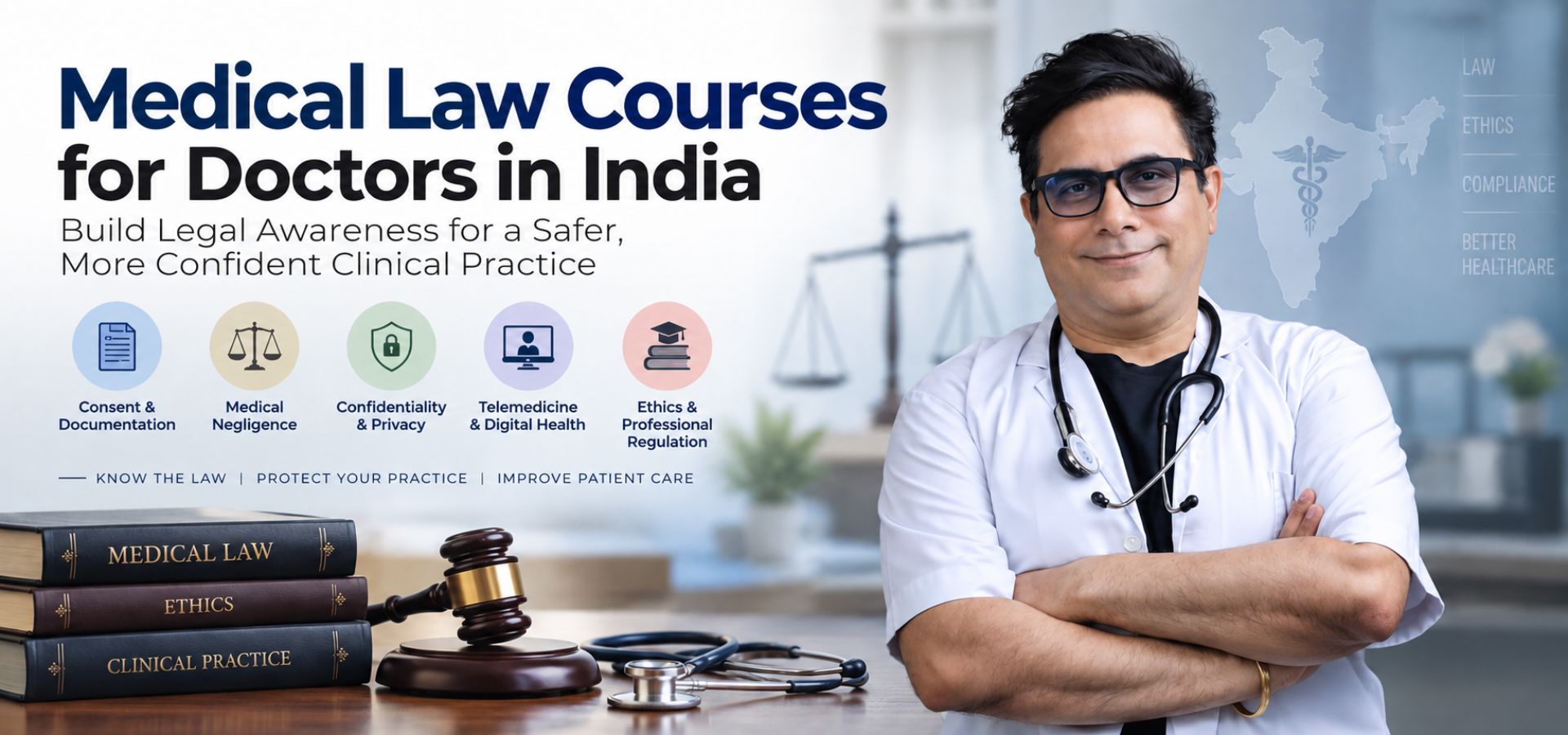
Medical law courses for doctors in India explain how consent, documentation, confidentiality, negligence, telemedicine and professional regulation affect everyday clinical decisions. They can strengthen legal awareness, but they do not qualify a doctor to practise law or replace advice on a specific dispute.
For practising doctors, residents and healthcare leaders, the most useful courses translate Indian legal and ethical principles into realistic clinical situations. A strong program should help learners recognise medico-legal issues, improve routine processes and know when to seek institutional or specialist legal support.
Indian Healthcare Law and Professional Regulation
Healthcare practice in India is shaped by statutes, regulations, professional standards and court decisions. The applicable rule can depend on the setting, the patient’s circumstances and the state in which care is delivered.
Under the National Medical Commission Act, 2019, the Ethics and Medical Registration Board regulates professional conduct and promotes medical ethics. As of September 2026, the NMC’s website also records that its Registered Medical Practitioner Professional Conduct Regulations, 2023 remain in abeyance, so doctors should check the current NMC and State Medical Council position rather than rely on an outdated summary.
Doctors may encounter legal and regulatory questions in several areas, including:
- Patient rights and informed consent
- Medical records and documentation
- Confidentiality and privacy
- Allegations of medical negligence
- Consumer complaints
- Telemedicine
- Professional conduct
- Healthcare data and digital records
- Regulatory and institutional compliance
Digital health adds another layer. India notified the Digital Personal Data Protection Rules, 2025 on 13 November 2025, with phased commencement. Some institutional provisions took effect immediately, Rule 4 is scheduled for 13 November 2026, and most substantive rules are scheduled for 13 May 2027. Healthcare organisations should therefore verify which provisions of the Act and Rules are in force when they collect, use, store or disclose digital patient data.
Telemedicine is governed by the Telemedicine Practice Guidelines issued in 2020 by the Board of Governors in supersession of the Medical Council of India and incorporated into the 2002 ethics regulations. The guidelines address patient and doctor identification, consent, confidentiality, documentation, prescribing and the clinician’s decision about whether remote care is appropriate.
The practical point is that medico-legal responsibilities arise in routine care, not only after a complaint. Consent conversations, medical records, patient communication and the handling of health information all deserve deliberate attention.
Topics Covered in Medical Law Courses for Doctors
Syllabi vary, but a useful course should cover the areas most likely to arise in Indian clinical practice.
Why Medical Law Education Matters in Clinical Practice
The value of medical law education is usually visible in routine decisions before a dispute begins.
Clearer Documentation
Doctors who understand the clinical and medico-legal purpose of records are more likely to document decisions clearly and at the time care is provided.
Documentation should accurately reflect the clinical process and support continuity of care. It should not be created merely as a defensive exercise.
More Reliable Consent Practices
Medical law training for doctors can improve conversations about the proposed treatment, its purpose, expected benefits, likely effects and complications, available alternatives, substantial risks and the consequences of refusing treatment.
Greater Awareness of Professional Duties
Legal education can help doctors recognise situations in which professional conduct requirements, institutional policies or legal obligations may apply.
Earlier Recognition of Complaints and Escalation
Doctors who understand the basic structure of medico-legal complaints may be better positioned to recognise when a matter requires institutional support, professional advice or specialist legal assistance.
A course does not replace representation or legal advice. It can help a practitioner recognise when a complaint needs prompt institutional support, indemnity notification or advice from a qualified lawyer.
Stronger Healthcare Governance
For doctors involved in hospital administration, clinical leadership or practice management, medico-legal knowledge can contribute to clearer policies, better documentation systems and more structured complaint-handling processes.
Choosing a Medical Law Certification for Doctors
Certificates vary widely in depth and recognition. Compare the curriculum, faculty, practical exercises, update process and the standing of the issuing organisation. Do not choose only by the title printed on the certificate.
Focus on Indian Law
The course should focus on Indian legislation, regulations, professional standards and relevant judicial developments rather than relying primarily on legal systems from other countries.
Faculty Expertise
Consider whether instructors have relevant experience in areas such as:
- Medical law
- Healthcare regulation
- Medico-legal practice
- Healthcare management
- Professional ethics
- Arbitration or dispute resolution
Case-based teaching is most useful when it accurately connects legal principles to clinical decisions, records, and communication.
Practical Learning
A useful course should connect legal concepts with real healthcare situations.
Depending on the curriculum, this may include:
- Consent documentation
- Medical-record scenarios
- Patient complaints
- Confidentiality issues
- Telemedicine situations
- Professional conduct questions
- Indian case-law analysis
- Healthcare dispute resolution
Current Course Content
Medical law changes through legislation, regulations, professional guidance and court decisions.
Before enrolling, check when the course material was last updated and whether the provider has a mechanism for keeping the curriculum current.
Meaning of the Certificate
Understand:
- Who issues the certificate
- What the credential represents
- Whether any accreditation or recognition is clearly stated
- Whether the qualification has academic or professional limitations
Unless it genuinely carries that status, a professional certificate is not a law degree, a licence to practise law or a specialist legal qualification.
Who Can Benefit From Medical Law Courses in India
Medical law education can be relevant to several groups of healthcare professionals, depending on the course.
How Medical Ethics and Medical Law Work Together
Medical ethics and medical law overlap, but they answer different questions.
Medical ethics concerns the professional values and principles that guide patient care. Medical law concerns enforceable duties, rights, regulations and judicial principles.
A decision can engage both.
For example, respecting patient autonomy is an important ethical principle and is closely connected with informed consent. Similarly, confidentiality is an important professional responsibility while also being subject to applicable legal and regulatory requirements.
Studying both helps doctors distinguish what the law requires from what professional ethics may demand in a particular situation.
The Practical Context Dr Arvinder Singh Brings
Medical law education is most useful when legal concepts are connected to realistic healthcare situations.
The course provider describes Dr Arvinder Singh’s background as spanning postgraduate medicine, healthcare management and legal education. That combination can provide clinical and organisational context for medico-legal teaching.
Credentials are only one part of the decision. Learners should also examine the complete curriculum, learning objectives, faculty expertise, delivery format, practical exercises and the date of the latest legal update.
How to Choose the Right Medical Law Course
Before enrolling in a medical law course, ask:
These questions help distinguish a substantive learning program from one centred mainly on issuing a certificate.
Key Takeaway
Medical law courses for doctors in India are most valuable when they improve everyday practice: clearer consent, accurate records, careful handling of patient information and earlier recognition of legal or ethical concerns.
Choose a course that is current, grounded in Indian law and built around practical cases. Treat it as professional education and risk awareness, not as a guarantee against complaints or as a substitute for advice from a qualified legal professional.
To review the provider’s syllabus, format, and certification details, visit the Medical Law and Ethics Course in India page before enrolling.