

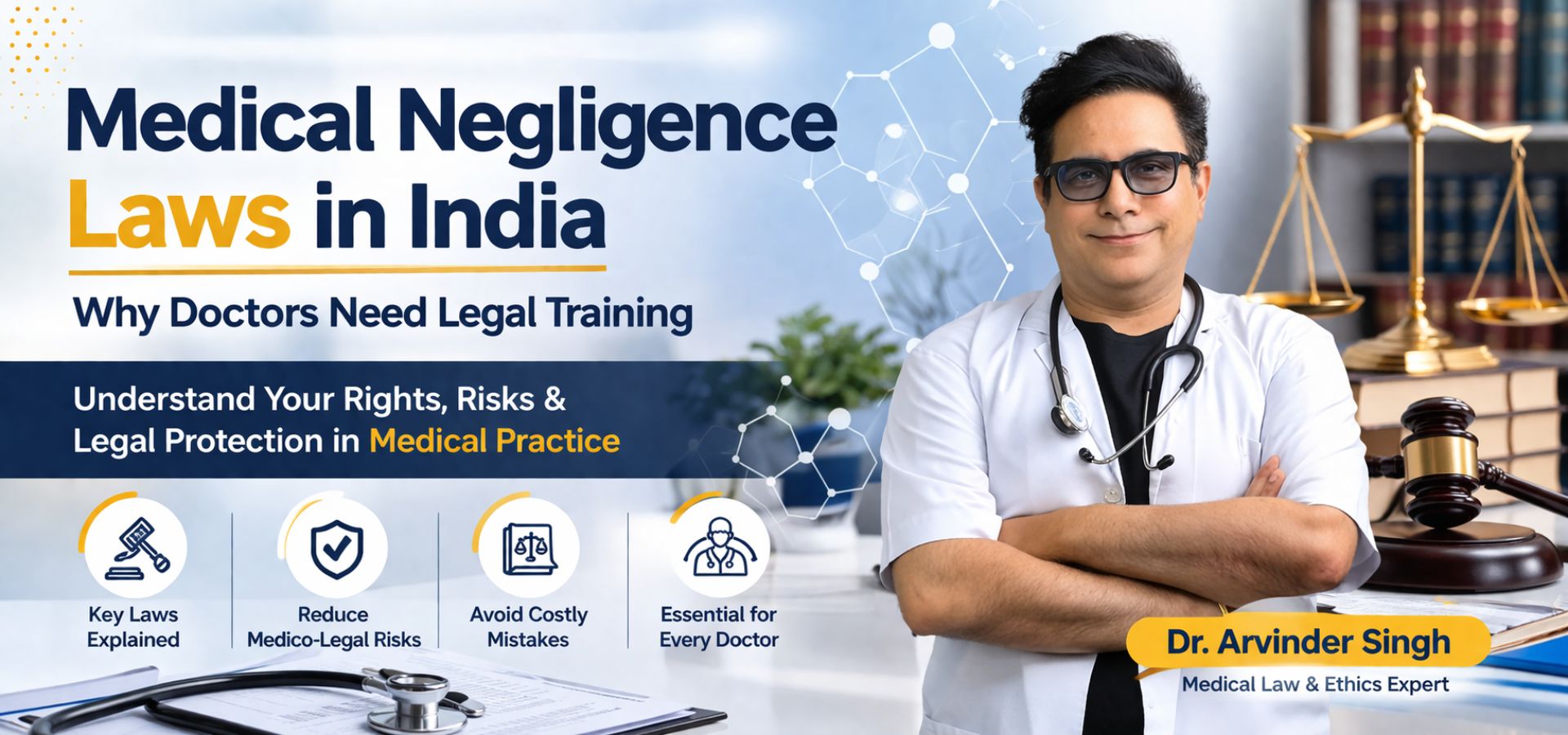
A surgeon leaves a swab inside a patient. A physician prescribes a drug the patient is allergic to, a fact clearly noted in the file. A gynaecologist fails to warn a patient about the risks of a procedure she subsequently suffers from. In each case, a doctor — trained, experienced, and well-intentioned — faces a medical negligence claim.
These are not rare occurrences. Consumer forums and civil courts across India are handling a growing volume of medico-legal cases, and the trend is accelerating as patients become more informed and more willing to hold doctors accountable.
Understanding medical negligence law in India is not about practicing defensively out of fear. It is about practicing intelligently — knowing what the law expects, where the risks lie, and how to protect yourself and your patients.
What Constitutes Medical Negligence in India?
Medical negligence, in the legal sense, is not simply a bad outcome. Not every complication is negligence, and not every patient’s dissatisfaction translates into a valid legal claim. The law has a specific test.
The foundational standard in India comes from the Supreme Court’s judgment in Jacob Mathew v. State of Punjab (2005).
For a broader understanding of these principles, you can also explore key legal principles every healthcare professional should know.
The Court held that a doctor cannot be held liable for negligence merely because a better course of treatment was available or a different doctor might have acted differently. The test is whether the doctor acted in accordance with a practice accepted as proper by a responsible body of medical professionals.
To establish negligence, three elements must be proven:
- Duty of care — A doctor-patient relationship existed, creating an obligation to provide care
- Breach of duty — The doctor’s conduct fell below the accepted standard of care
- Causation and harm — The breach directly caused the patient’s injury or worsened their condition
All three elements must be established. A breach that caused no harm, or a harm that was not caused by any breach, does not make out a negligence claim.
The Legal Framework: Which Laws Apply?
Medical negligence in India is governed by several overlapping legal frameworks. A single incident can give rise to proceedings under more than one of these simultaneously.
1. The Consumer Protection Act, 2019
This is the most commonly invoked law in medical negligence cases. Following the Supreme Court’s landmark ruling in Indian Medical Association v. V.P. Shantha (1995), medical services rendered for a fee were brought within the definition of ‘services’ under consumer law. Patients can approach District, State, or National Consumer Commissions for compensation.
The Consumer Protection Act, 2019 replaced the earlier 1986 Act and introduced an e-filing mechanism, a central consumer protection authority, and enhanced penalties. Complaints can now be filed online, lowering the barrier for patients to initiate proceedings.
2. The Indian Penal Code / Bharatiya Nyaya Sanhita
In cases of gross negligence resulting in death or serious injury, doctors can face criminal prosecution. Section 304A of the IPC (now Section 106 of the Bharatiya Nyaya Sanhita, 2023) covers causing death by a rash or negligent act. The Jacob Mathew judgment drew an important distinction: criminal liability requires a ‘gross’ departure from reasonable care, not merely a civil standard breach. However, in practice, the threat of criminal proceedings is used to pressure doctors, making legal awareness critical.
3. National Medical Commission Act, 2020
The NMC and State Medical Councils retain disciplinary jurisdiction over registered medical practitioners. A complaint to the relevant council can result in a warning, temporary suspension, or permanent removal from the register. These proceedings are independent of civil or criminal cases and can run concurrently.
4. The Law of Torts
Outside the consumer forum, patients can also bring a civil suit for damages in a civil court under the law of torts. While this route is less common, it is available, particularly in cases involving higher compensation claims.
Landmark Judgments Every Doctor Should Know
Indian courts have developed the law of medical negligence significantly over the past three decades. A working knowledge of key judgments helps doctors understand how courts think.
Jacob Mathew v. State of Punjab (2005)
The Supreme Court clarified that a doctor is not liable for negligence simply because something went wrong. The Bolam test — that a doctor is not negligent if they act in accordance with accepted medical practice — was affirmed as the standard in India. The Court also cautioned against the misuse of criminal law against doctors and set guidelines requiring expert opinion before arrest.
Spring Meadows Hospital v. Harjol Ahluwalia (1998)
The Supreme Court held that both the hospital and the nurse who administered a wrong injection to a child were liable. The case established that hospitals can be held vicariously liable for the acts of their staff, and that the parents of a child patient are also ‘consumers’ entitled to claim compensation for mental anguish.
V. Kishan Rao v. Nikhil Super Specialty Hospital (2010)
The Supreme Court held that in straightforward cases of negligence, expert evidence is not always required. A Consumer Forum can apply common sense and logic to determine whether the standard of care was met. This significantly lowered the evidential threshold for patients in consumer proceedings.
Types of Medical Negligence: Recognising the Risk Areas
Negligence can arise in virtually any aspect of clinical practice. The following categories represent the most frequently litigated.
Diagnostic Negligence
Failure to diagnose a condition, delayed diagnosis, or misdiagnosis that leads to a patient receiving incorrect or no treatment. Common examples include missed malignancies, undiagnosed fractures, and delayed sepsis recognition.
Surgical Negligence
Errors during surgery — operating on the wrong site, leaving foreign objects inside the body, damaging adjacent structures unnecessarily, or failing to manage intraoperative complications appropriately. Post-operative care failures also fall in this category.
Medication Errors
Prescribing a contraindicated drug, failing to check allergy history, incorrect dosage, or failure to monitor for known drug interactions. With the rise of electronic prescribing, such errors are increasingly difficult to explain away.
Failure to Obtain Informed Consent
A procedure performed without the patient’s informed consent can constitute both negligence and a battery in law. Informed consent means the patient was told about the nature of the procedure, its material risks, its benefits, and available alternatives — in a language they understood, and without coercion. A signed form alone is not sufficient if the conversation was not had.
This is one of the most critical medico-legal areas. Read in detail: Informed consent in medical practice in India
Failure of Supervision and Delegation
Senior doctors who delegate procedures to junior colleagues or trainees without adequate supervision can be held liable for the trainee’s actions. Hospitals can similarly face vicarious liability for the acts of their employed staff.
How Doctors Can Protect Themselves Legally
Legal protection for doctors is available — but it requires proactive practice. The following are not bureaucratic formalities. They are your primary defences in any legal proceeding.
Maintain Thorough Medical Records
Medical records are the single most important piece of evidence in any negligence case. They should document the clinical history, examination findings, differential diagnoses considered, investigations ordered and their results, the treatment plan and the reasoning behind it, and the patient’s response. Sparse, illegible, or retrospectively altered records are the leading cause of doctors losing cases they should win.
Obtain and Document Informed Consent Properly
For any significant procedure or treatment, consent should be documented in writing, with a contemporaneous note of the discussion that took place. The note should record what risks were disclosed, what questions the patient asked, and their decision. Generic consent forms without individual discussion offer minimal protection.
Follow Standard Treatment Protocols
Deviation from established clinical guidelines is not automatically negligent if the deviation was justified and documented. However, if you depart from a standard protocol, record your clinical reasoning explicitly. Courts look for evidence that the decision was made thoughtfully, not carelessly.
Communicate Clearly and Document That Communication
Many negligence claims arise not from clinical error but from breakdown in communication. A patient who feels uninformed or ignored is far more likely to litigate. Document patient counselling, discharge instructions, follow-up advice, and warnings about warning signs.
Understand When to Refer
Continuing to manage a patient beyond your competence, or failing to refer when a specialist opinion is indicated, is a recognised form of negligence. When in doubt, refer, and document the referral.
Doctors who want structured guidance on managing legal risks can explore medical law coaching for doctors to build practical, real-world legal confidence.
Criminal Negligence: A Specific Risk Doctors Must Understand
The threat of criminal prosecution is a particular concern for doctors in India. FIRs are sometimes lodged against doctors in circumstances that do not meet the legal threshold for criminal liability.
The Jacob Mathew guidelines require that before any arrest or prosecution in a case of alleged medical negligence, the investigating officer should obtain an independent expert opinion from a doctor in a government hospital in the relevant speciality. Courts have reiterated this requirement several times. Doctors who face an FIR should seek legal counsel immediately and should be aware that bail in such matters is ordinarily available.
The distinction between civil and criminal negligence is important: civil negligence requires proof that the doctor fell below the standard of a reasonably competent practitioner. Criminal negligence requires proof of gross and culpable carelessness — a significantly higher bar.
Documentation: Your Most Powerful Legal Tool
It is worth returning to this point because it is so frequently underestimated. In the majority of medical negligence cases that result in adverse findings against doctors, poor documentation is a significant contributing factor.
Courts cannot assess what you were thinking at the time of treatment. They can only assess what you wrote down. A well-maintained medical record tells the story of a careful, thoughtful clinician. A poorly maintained one tells a story of carelessness, even when none existed.
Specific documentation practices that matter:
- Date and time every entry
- Record clinical reasoning, not just decisions
- Document conversations with patients and their families
- Note when a patient refuses advice or treatment
- Record every referral, with the reason and outcome
- Never alter records after an adverse event — this can convert a negligence claim into a fraud allegation
Why Legal Training Is No Longer Optional for Doctors
Medical education in India trains doctors to diagnose and treat. It does not, in any systematic way, train them to navigate the legal environment in which they practice. This gap has become increasingly costly.
A doctor who understands the Bolam standard knows when their clinical decision was defensible. A doctor who understands consumer law knows the forum they are likely to face. A doctor who understands informed consent law knows what ‘consent’ actually requires legally, not just administratively.
Legal training for doctors covers:
- The legal elements of negligence and how courts assess them
- Rights and obligations in doctor-patient relationships
- How to read and respond to a legal notice
- Documentation standards that withstand legal scrutiny
- How medico-legal proceedings work in practice
- Interaction between professional disciplinary proceedings and civil or criminal cases
Doctors who have invested in this knowledge handle difficult clinical situations with greater clarity, communicate more effectively with patients, and are significantly better placed if a legal challenge does arise.
Conclusion
Medical negligence law in India is not designed to criminalise good-faith clinical practice. It is designed to set standards and provide recourse when those standards are not met. Doctors who understand the law are not disadvantaged by it — they are protected by it.
The legal framework — from the Consumer Protection Act and the Jacob Mathew guidelines to the NMC’s ethical regulations — gives doctors who practice carefully, document thoroughly, and communicate honestly a robust set of defences. The same framework exposes those who do not.
If you want to protect your medical career, avoid costly legal mistakes, and practice with confidence, it’s time to go beyond clinical knowledge.
Explore the Medical Law and Ethics Course in India — a structured program designed specifically for doctors to master medico-legal challenges, improve documentation, and handle real-world legal situations effectively.
Frequently Asked Questions
Is every bad clinical outcome a case of negligence?
No. The law recognises that medicine involves inherent uncertainty and that complications can occur without any fault. Negligence requires proof that the doctor’s conduct fell below an accepted standard of care, not simply that the outcome was poor.
Can a doctor be held criminally liable for an honest mistake?
Criminal liability requires gross negligence — a standard significantly higher than civil negligence. An honest error of judgment, without gross carelessness, does not ordinarily attract criminal liability. However, the Jacob Mathew guidelines notwithstanding, FIRs against doctors do occur, making it important to understand your rights and seek legal advice promptly if one is filed.
What is the limitation period for filing a medical negligence complaint?
Under the Consumer Protection Act, a complaint must generally be filed within two years of the cause of action arising — typically when the patient discovered, or should have discovered, the negligence. Courts have the discretion to condone delay in appropriate circumstances. Civil suits in tort are generally governed by a three-year limitation period.
Can a doctor be sued even if they treated a patient in an emergency without consent?
Emergency treatment provided in the absence of consent, where obtaining consent was not reasonably possible, is generally protected. The law recognises implied consent in genuine emergencies. Documenting the emergency circumstances at the time is advisable.
Does signing a consent form fully protect a doctor from negligence claims?
No. A signed form is evidence that consent was sought, but courts look beyond the form. If the patient was not properly informed of material risks, if the form was signed in coercive circumstances, or if the clinical care itself was negligent, the consent form provides limited protection. Proper documentation of the consent conversation is equally important.
Can junior doctors or residents be personally held liable?
Yes. Any registered medical practitioner can be held personally liable for their own acts of negligence. Additionally, the supervising doctor and the hospital may also be held vicariously liable. Junior doctors should be particularly careful to escalate and document when they are managing cases beyond their competence.