
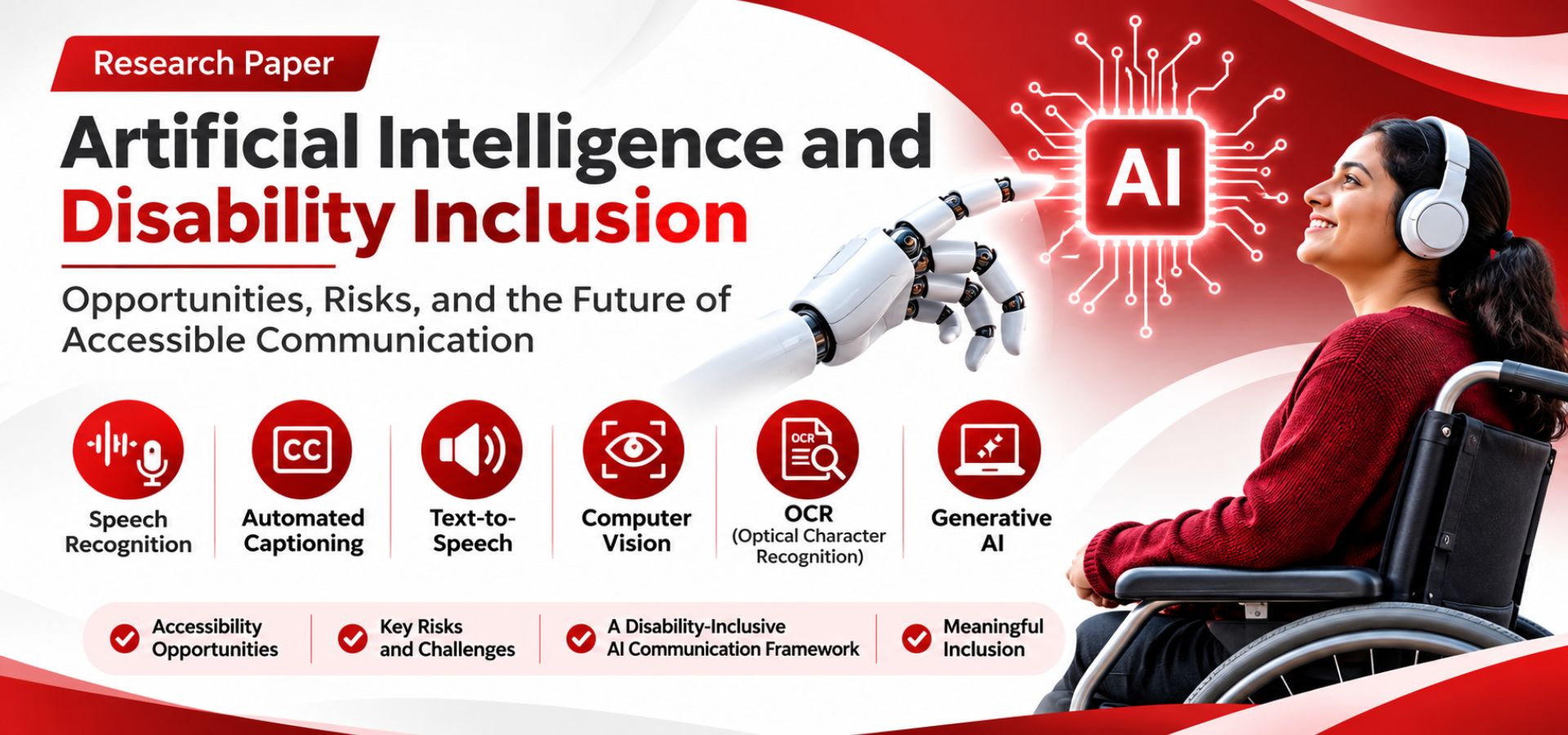
Artificial Intelligence (AI) is transforming how information is produced, processed and communicated. For persons with disabilities, AI-enabled technologies such as speech recognition, automated captioning, text-to-speech, computer vision, optical character recognition and generative AI offer new possibilities for accessible communication. At the same time, these technologies may create new barriers through algorithmic bias, inaccurate outputs, inaccessible interfaces, privacy concerns, excessive cognitive demands and unequal access.
This article examines the opportunities and risks associated with AI-enabled accessible communication from a disability-inclusion perspective. A PRISMA 2020-informed integrative literature review approach was adopted to examine peer-reviewed literature published between 2020 and 2026, together with relevant international accessibility and disability-rights frameworks. The literature was analysed thematically across six areas: AI as an accessibility enabler, personalised and multimodal communication, disability-specific applications, algorithmic bias, privacy and autonomy, and digital inequality.
The review indicates that AI can expand communication choices and support greater independence, but technological capability alone does not guarantee meaningful inclusion. The article proposes a Disability-Inclusive AI Communication Framework based on accessibility, AI capability, communication access, user agency and meaningful inclusion, supported by cross-cutting safeguards such as accuracy, transparency, privacy, bias mitigation, human oversight and disability-led co-design.
The article argues that persons with disabilities should participate not merely as users of AI technologies but as active contributors to their design, testing and governance.