

Financial inclusion is an essential component of economic equality, individual independence and inclusive development. However, access to banking services remains challenging for many persons with disabilities because of inaccessible bank branches, unsuitable ATMs, discriminatory practices, inadequate customer assistance and digital platforms that are incompatible with assistive technologies.
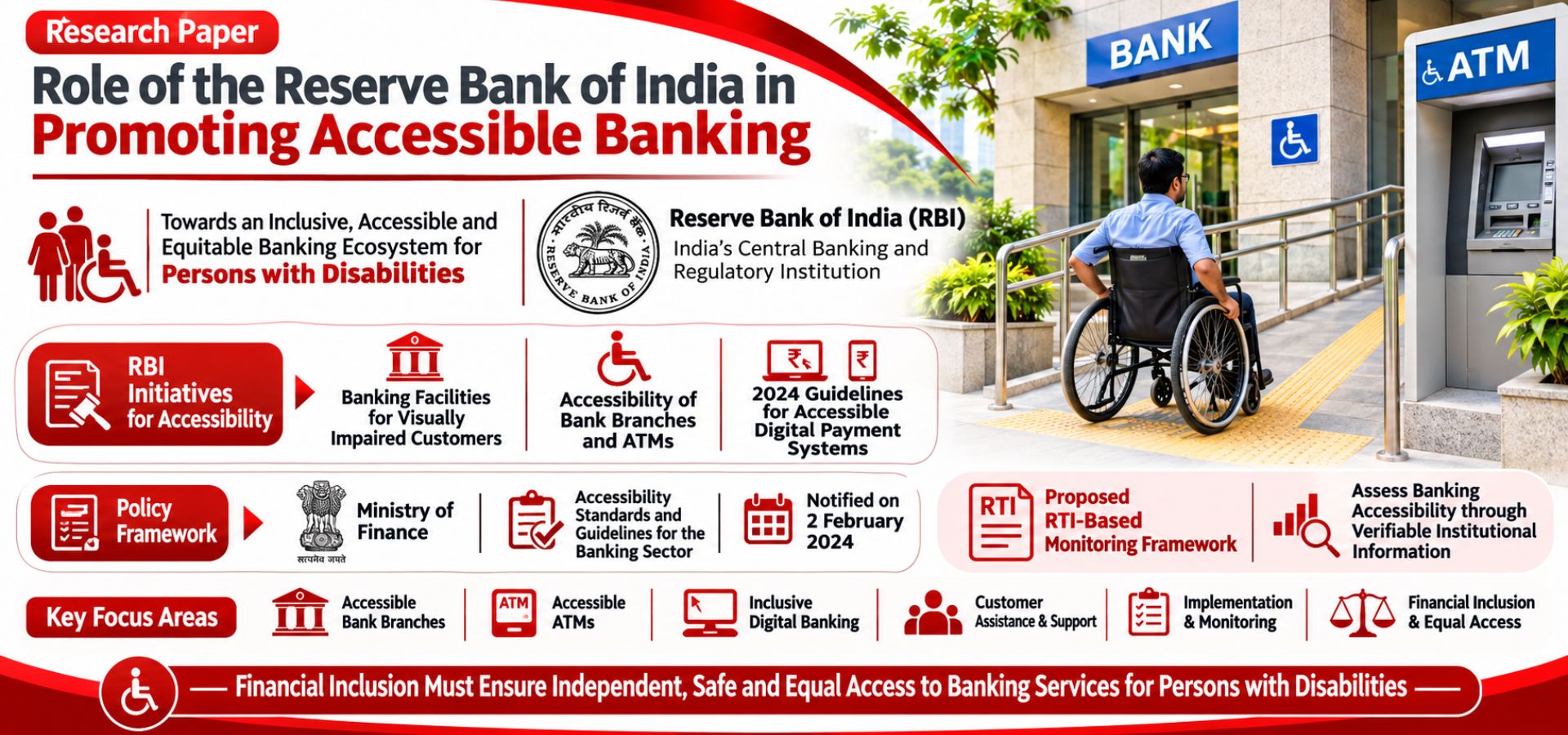
The Reserve Bank of India (RBI), as India’s central banking and regulatory institution, plays a significant role in shaping an accessible and equitable banking ecosystem. Through regulatory instructions, customer-service directions and accessibility-related initiatives, RBI has progressively addressed the banking requirements of persons with disabilities. Important developments include its instructions on banking facilities for visually impaired customers, accessibility of bank branches and ATMs, and the 2024 guidelines facilitating accessibility to digital payment systems.
The Ministry of Finance’s Accessibility Standards and Guidelines for the Banking Sector, notified on 2 February 2024, provide an additional framework for improving accessibility across banking infrastructure and services. This article critically examines RBI’s regulatory role in promoting accessible banking in India. It analyses the legal and institutional framework, identifies significant barriers in physical and digital banking, and evaluates the need for stronger implementation and monitoring mechanisms. It also proposes an RTI-based monitoring framework through which banking accessibility can be assessed using verifiable institutional information.
The article argues that financial inclusion must extend beyond account ownership and transaction availability. Genuine inclusion requires that persons with disabilities can independently, safely and equally access, understand and use banking services without discrimination.