

Infrastructure determines whether people can reach essential services, participate in public life and exercise their rights. Yet infrastructure development is often assessed through construction outputs and service capacity without consistently examining whether persons with disabilities can independently access and use the resulting facilities. This paper examines disability care and inclusive infrastructure in India through a human-rights, legal and evidence-based lens.
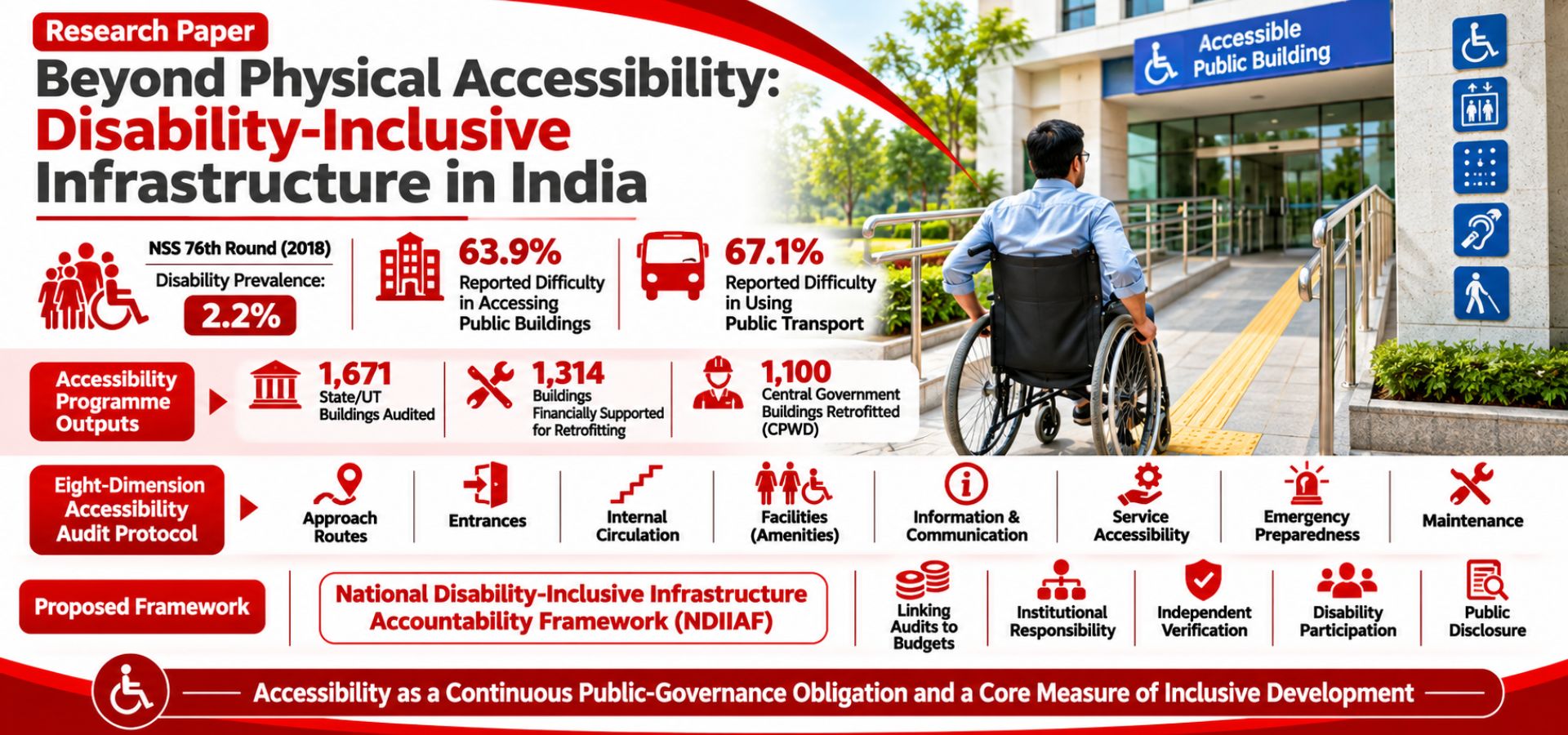
The study combines doctrinal legal analysis and a review of academic literature with secondary analysis of official Indian disability statistics and government-reported accessibility programme outputs. The National Statistical Office’s NSS 76th Round survey (July–December 2018), published as Report No. 583, estimated disability prevalence at 2.2 per cent. Among persons with disabilities who had accessed a public building during the preceding 365 days, 63.9 per cent reported difficulty; among those who had used public transport, 67.1 per cent reported difficulty.
Government reporting on the Accessible India Campaign records 1,671 State/UT government buildings audited and financial assistance for retrofitting 1,314 buildings; separate CPWD reporting records retrofitting of 1,100 central government buildings. These administrative outputs demonstrate programme activity but do not, by themselves, establish nationwide compliance or user-level accessibility.
The paper proposes a CPWD-informed, eight-dimension audit protocol covering approach routes, entrances, internal circulation, facilities, information and communication, service accessibility, emergency preparedness, and maintenance. It also proposes a National Disability-Inclusive Infrastructure Accountability Framework (NDIIAF) linking audits to budgets, institutional responsibility, independent verification, disability participation and public disclosure. No original field audit results are claimed. The proposed protocol requires pilot testing and validation.
The paper argues that accessibility must be treated as a continuous public-governance obligation and a core measure of inclusive development, rather than as an additional architectural feature.