

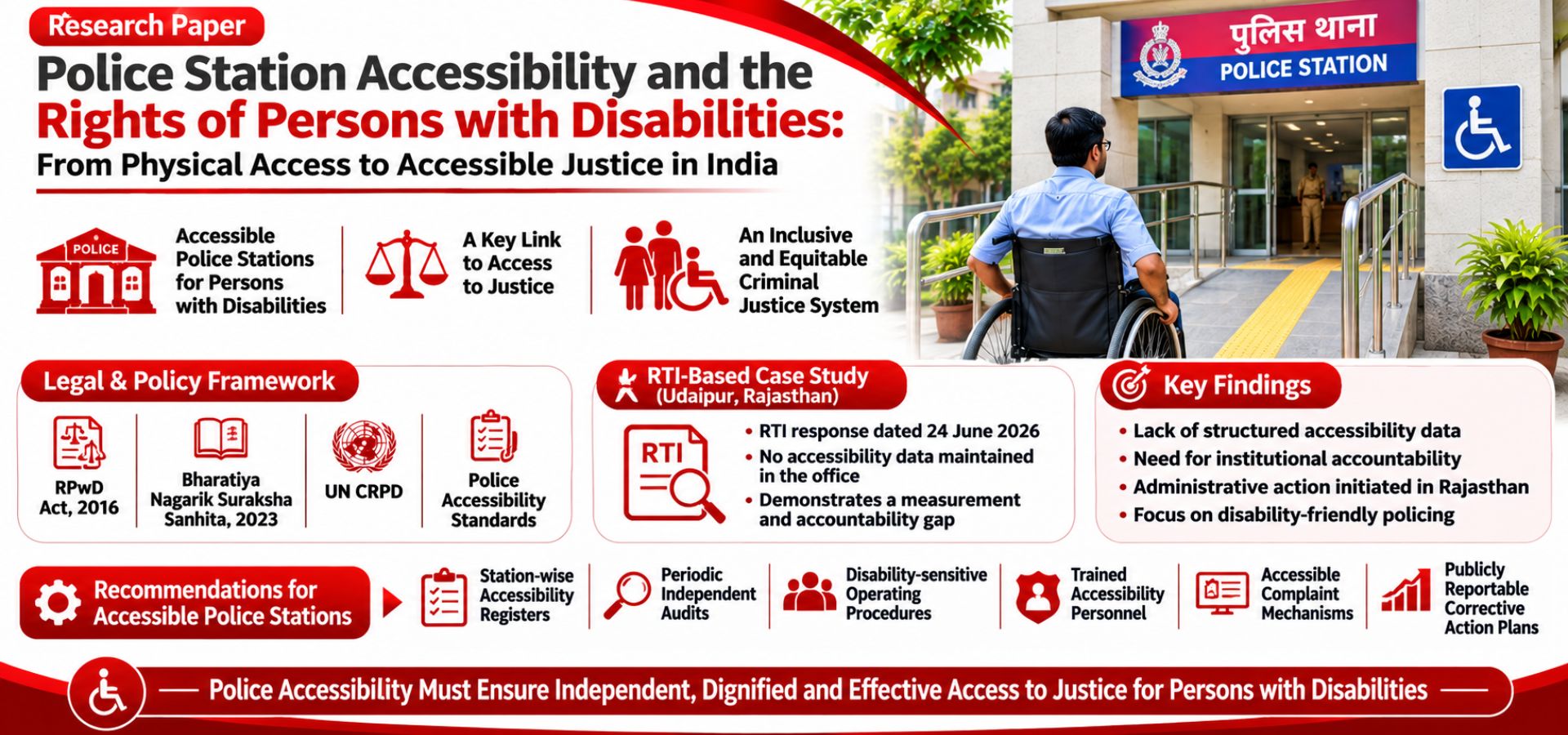
Police stations are often the first institutional point of contact with the criminal justice system for victims, complainants, witnesses, and accused persons. For persons with disabilities, inaccessible infrastructure, communication barriers, and the absence of procedural accommodation may transform a formally available justice system into one that cannot be independently or effectively accessed.
Objective: This study examinespolice-station accessibility as a component of access to justice for persons with disabilities in India, using documentary evidence generated through Right to Information (RTI) proceedings and subsequent administrative intervention in Rajasthan, interpreted against the Rights of Persons with Disabilities Act, 2016, the Bharatiya Nagarik Suraksha Sanhita, 2023, the United Nations Convention on the Rights of Persons with Disabilities, and India’s sector-specific accessibility standards for police infrastructure.
Methods: A documentary legal-policy case-study design was employed. Primary material included an official RTI response issued by the Office of the Additional Superintendent of Police, Udaipur City, Rajasthan, dated 24 June 2026, and documented subsequent representations and administrative communications concerning disability-friendlypolice stations in Rajasthan. These materials were analysed alongside statutory provisions, noted accessibility standards, judicial decisions and international literature concerning disability and law-enforcement interaction.
Results: The Udaipur police authority responded that the accessibility-related information requested through RTI was not maintained in the office in any form and therefore substantive information could not be provided. The importance of this response lies not in proving physical non-accessibility of any particular police station, but in demonstrating a measurement and accountability gap: the relevant office could not produce a structured accessibility dataset responsive to the request. Subsequent representations elevated the issue to Rajasthan’s senior police and Home Department structures and generated administrative communications concerning disability-friendly policing.
Conclusion: Police accessibility should be understood as a continuous justice-access pathway, not as a building feature. Compliance requires three interdependent dimensions: physical accessibility, procedural and communication accessibility, and measurable institutional governance. Police administrations should establish station-wise accessibility registers, periodic independent audits, disability-sensitive operating procedures, trained accessibility personnel, accessible complaint mechanisms, and publicly reportable corrective action plans.