

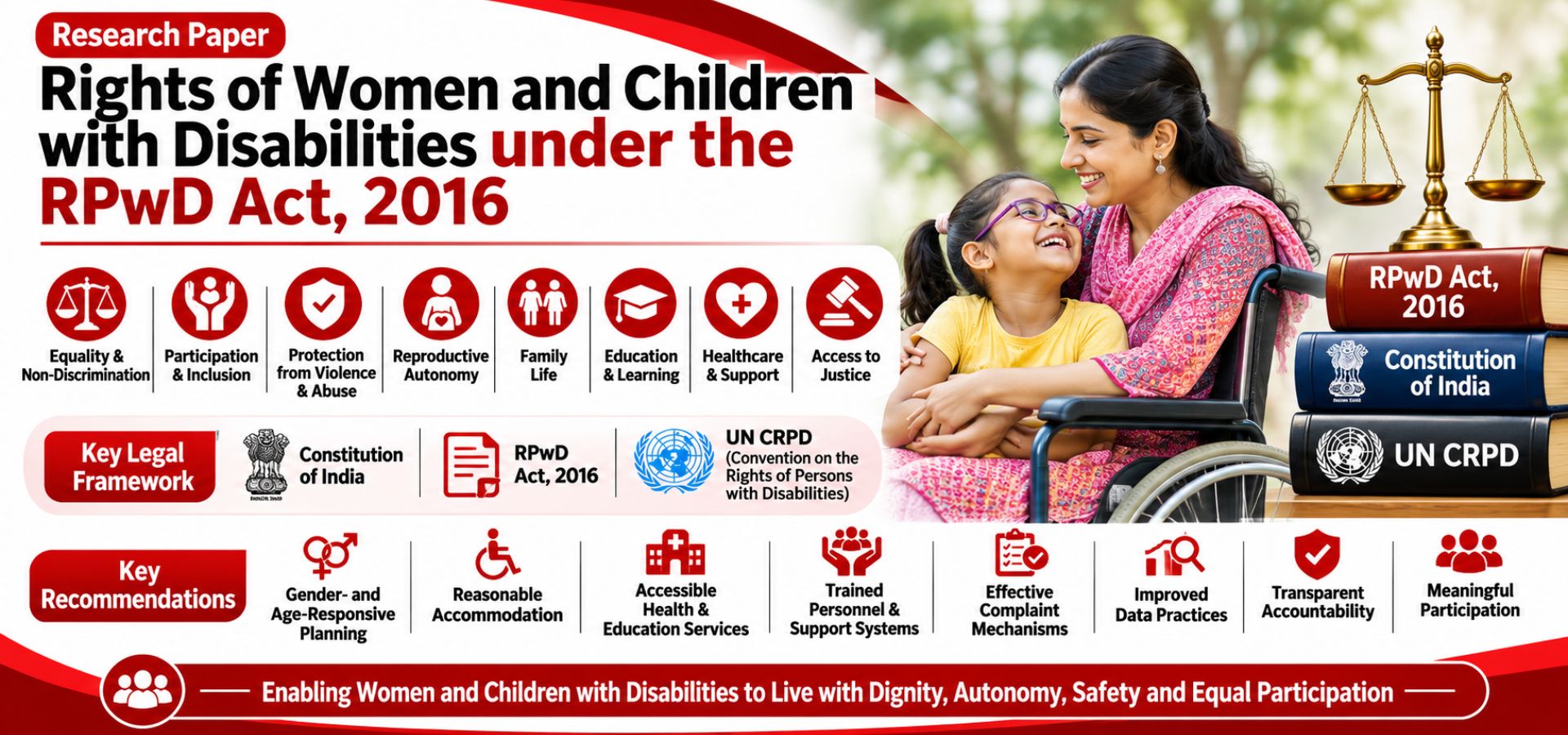
Women and children with disabilities occupy a particularly vulnerable position where disability intersects with gender, age, poverty, social status and inaccessible institutions. Although the Rights of Persons with Disabilities Act, 2016 (RPwD Act) establishes a rights-based framework, the existence of statutory guarantees does not by itself ensure their effective enjoyment. This paper examines the legal architecture governing the rights of women and children with disabilities in India, with particular attention to equality, participation, protection from violence, reproductive autonomy, family life, education, healthcare and access to justice. The study adopts a doctrinal and qualitative socio- legal documentary methodology.
It analyses the Constitution of India, the RPwD Act and relevant subordinate legal frameworks, the United Nations Convention on the Rights of Persons with Disabilities, selected judicial decisions and secondary literature. It does not claim original interviews, surveys or field observations. The analysis identifies a central implementation problem: rights are distributed across multiple statutory provisions and institutions, while practical access depends on coordinated administration, accessible infrastructure and information, trained personnel, reasonable accommodation, effective complaint mechanisms and meaningful participation by women and children with disabilities.
The paper argues that Section 4 should operate as a cross-cutting implementation obligation rather than a symbolic declaration. It recommends gender- and age-responsive planning, stronger safeguards against violence and coercion, accessible health and education services, child-sensitive participation, improved data practices and transparent accountability mechanisms. The central conclusion is that the measure of the Act’s success is not the formal recognition of rights alone, but whether women and children with disabilities can exercise those rights with dignity, autonomy, safety and equal participation.