

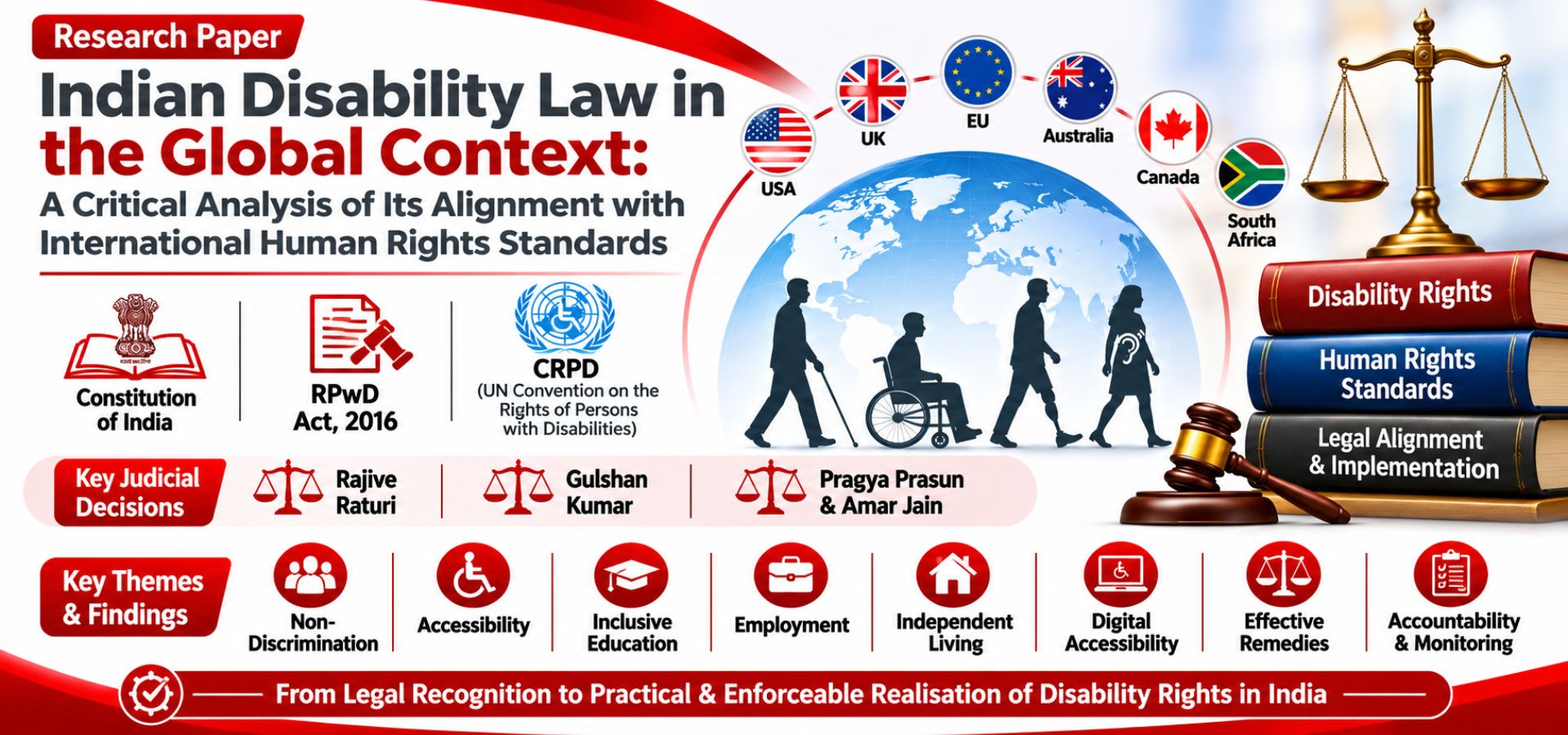
India’s disability-rights framework has undergone a significant normative transformation, most visibly through the Rights of Persons with Disabilities Act, 2016 (RPwD Act), enacted to give effect to the United Nations Convention on the Rights of Persons with Disabilities (CRPD). This article evaluates the extent to which Indian constitutional law, legislation, judicial decisions and implementation arrangements correspond with international human-rights standards. It adopts doctrinal and functional-comparative methods, examining the CRPD, the UN Committee’s interpretive materials, Indian legislation and leading Supreme Court decisions, alongside selected approaches in the United States, United Kingdom, European Union, Australia, Canada and South Africa.
It argues that India has achieved substantial formal alignment in relation to non-discrimination, accessibility, reasonable accommodation, inclusive education and employment. Yet legal capacity, independent living, intersectional equality, digital accessibility and effective remedies remain areas of incomplete alignment. Recent decisions—particularly Rajive Raturi, Gulshan Kumar, and Pragya Prasun and Amar Jain—show an increasingly substantive judicial understanding of accessibility and accommodation. Nevertheless, judicial recognition cannot substitute for routine administrative compliance, accessible public procurement, independent monitoring and outcome-based audits.
The article proposes a shift from fragmented, complaint-led enforcement towards a proactive accountability model that measures whether persons with disabilities can use services independently, safely and with dignity. It concludes that the central challenge for India is no longer merely to recognise disability rights in law, but to institutionalise their practical and enforceable realisation.