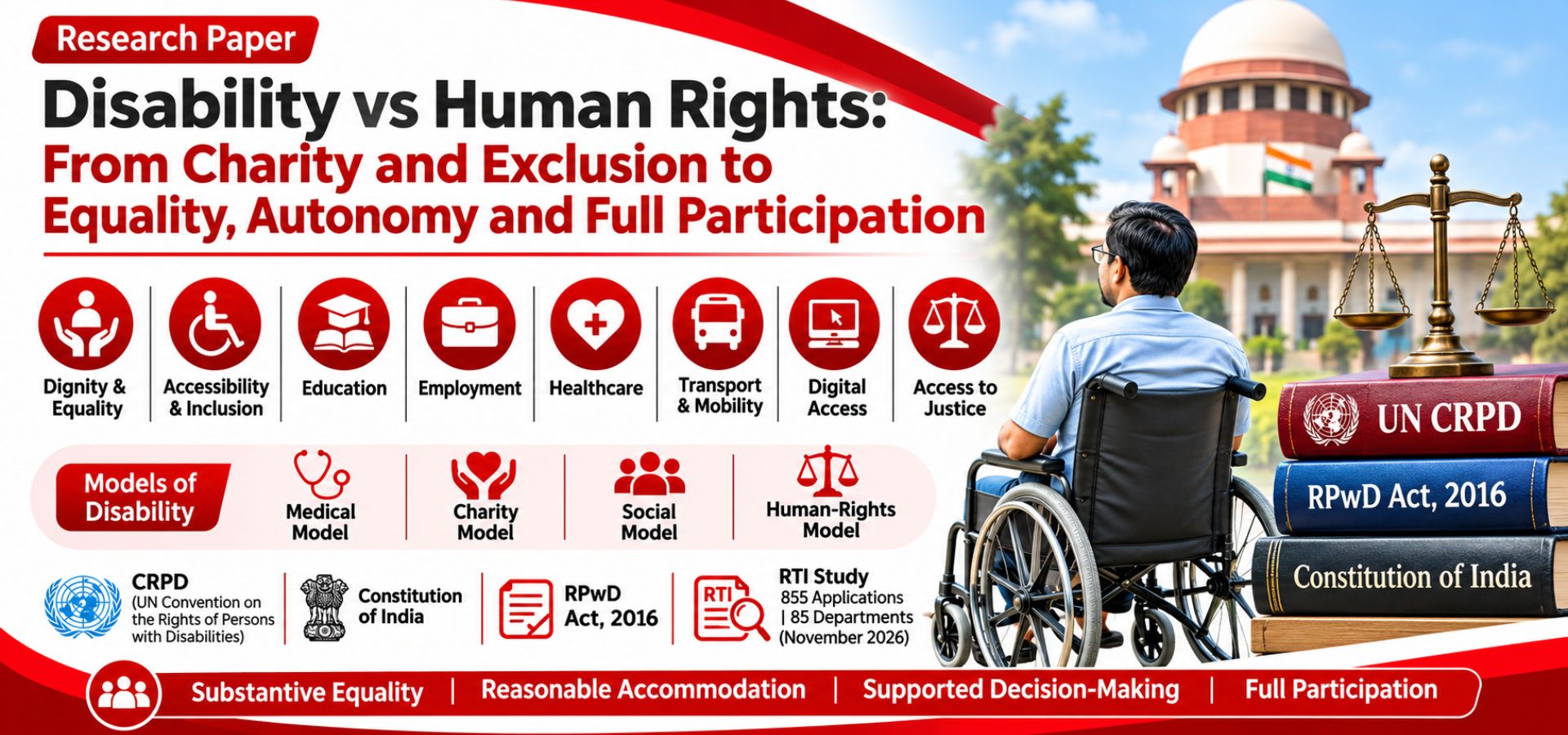
Disability is increasingly recognised as a human-rights issue rather than solely an individual medical condition or a matter of charity. International and domestic legal frameworks affirm that persons with disabilities are entitled to dignity, autonomy, equality, accessibility and full participation. Yet legal recognition has not removed the barriers that restrict access to education, employment, healthcare, transport, public services, digital platforms and justice. This paper examines the gap between formal rights and their effective enjoyment through the medical, charity, social and human-rights models of disability.
It analyses the United Nations Convention on the Rights of Persons with Disabilities (CRPD), India’s constitutional framework and the Rights of Persons with Disabilities Act, 2016 (RPwD Act), alongside selected Indian judicial decisions. It further incorporates an organisational documentary case study based on Panacea Disability Rights Activists’ RTI Summary Sheet (November 2026), which records 855 RTI applications across 85 departments/offices in central and Rajasthan State institutions, covering nine broad sectors. The RTI dataset illustrates how transparency can be used to seek documentary evidence about accessibility, facilities, staff training and institutional accountability; it does not, by itself, establish the compliance or non-compliance of the institutions approached.
Adopting a doctrinal and socio-legal approach supported by descriptive analysis of this organisational dataset, the paper argues that disability-related exclusion often results from inaccessible systems and institutional practices rather than impairment alone. It concludes that substantive equality requires enforceable accessibility, reasonable accommodation, supported decision-making, effective remedies, adequate resources, and meaningful participation by persons with disabilities in decisions affecting them.